Imagine directing a theatre play where every actor must move, speak, and react with perfect timing. The audience sees a seamless performance, but backstage, every gesture is scripted with meticulous detail.
Software requirements work much the same way. To deliver a flawless user experience, teams need scripts that clearly describe behaviour, expectations, and outcomes.
This is where Gherkin-based acceptance criteria shine — a structured storytelling technique that transforms vague requirements into precise, testable scenarios. Instead of long-winded explanations, Gherkin provides a simple theatrical script: Given a context, When an action occurs, Then an expected result must follow.
Why Requirements Need a Stage Script
In many projects, requirements are written like abstract poetry — open to interpretation and ambiguity. Developers imagine one behaviour, testers another, and product owners yet another.
Gherkin solves this by treating each requirement as a scene in a play. The narrative becomes consistent, predictable, and easy to follow.
Professionals who expand their skills in structured requirement techniques through formal learning, such as business analyst classes in chennai, often find that Gherkin eliminates miscommunication more effectively than traditional prose.
The Power of Given–When–Then: A Storytelling Blueprint
Gherkin’s structure is intentionally simple and human-readable. Each testable requirement follows a three-part rhythm:
- Given – Establish the stage, the background, the conditions before action.
- When – Define the trigger or event that moves the story forward.
- Then – Describe the outcome that must occur.
An Example
Given a user is logged in
When they click “Download Report”
Then the report should download successfully
This is not just a script — it’s an unambiguous contract of expected behaviour.
Breaking Down Scenarios: From Big Ideas to Testable Steps
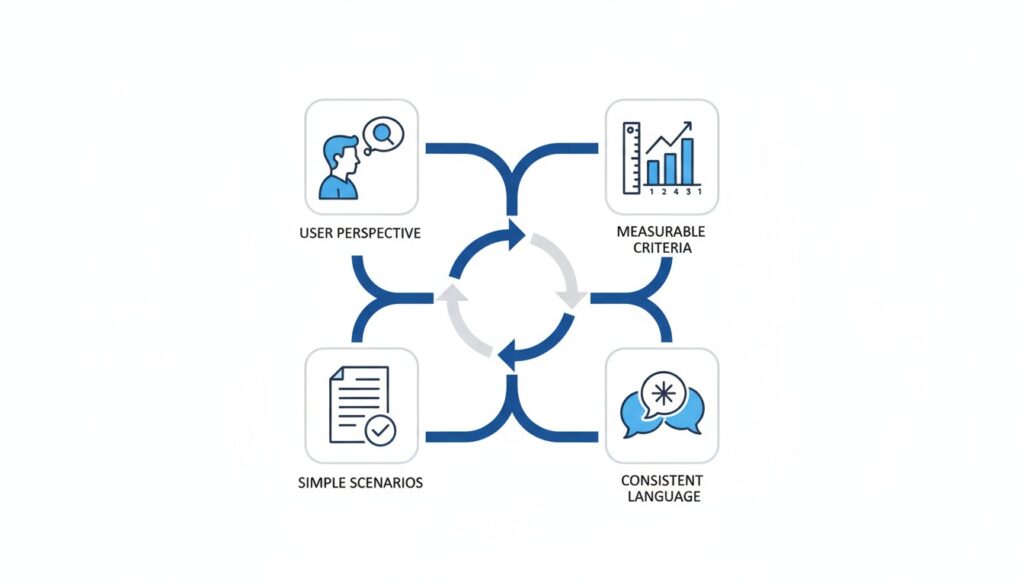
Complex requirements can overwhelm teams if written as a single block of text. Gherkin encourages breaking them into smaller scenarios, each representing a meaningful user behaviour.
Scenario Types
- Happy Path Scenarios: Everything works exactly as expected.
- Alternate Paths: Users take a different route from the ideal journey.
- Exception Scenarios: Something fails — and the system must handle it gracefully.
By diversifying scenarios, teams explore edge cases they might otherwise overlook.
This structured exploration ensures the product behaves consistently across all user interactions.
Shared Understanding: Where Development Meets Design and QA
Gherkin encourages collaboration. Because the language is non-technical, everyone — developers, testers, designers, product managers — participates in crafting acceptance criteria.
Benefits of This Shared Language
- Reduces back-and-forth clarification
- Aligns expectations early
- Improves estimation accuracy
- Ensures testing reflects real user behaviour
This collaborative clarity becomes especially powerful in fast-paced Agile environments where speed and accuracy must coexist.
Turning Criteria into Automated Tests
One of Gherkin’s biggest strengths is its compatibility with automation frameworks such as Cucumber, SpecFlow, and Behave.
Once acceptance criteria are written, they can be turned directly into executable automated tests.
How This Helps Teams
- Prevents regression bugs
- Ensures new features honour old scenarios
- Saves time during release cycles
- Brings human language and machine logic together
Teams today increasingly integrate automation into their workflow as part of modern delivery pipelines, often encouraged by structured learning foundations like business analyst classes in chennai, where behaviour-driven development concepts are commonly introduced.
Avoiding the Pitfalls: Writing Gherkin That Works
Even though Gherkin is simple, it can be misused.
To ensure effectiveness, follow these principles:
- Focus on behaviour, not implementation details
- Avoid overly technical language
- Keep scenarios short and clear
- Ensure each scenario has one clear outcome
- Write in active voice to show flow
Gherkin should read like a script, not like documentation.
Conclusion
Acceptance criteria written in Gherkin are more than technical artefacts — they are shared stories that guide the entire team toward building the right product.
By structuring requirements as scenes with clear context, action, and outcomes, teams eliminate ambiguity and foster collaboration.
In an era where speed is essential and quality is non-negotiable, Gherkin’s Given–When–Then framework becomes the storyteller that ensures every feature behaves exactly as intended.