Russia has been one of the most consistently chosen destinations for Indian medical students for over three decades. More than 20,000 Indian students are currently enrolled in Russian medical programmes, drawn by affordable government-funded universities, English-medium instruction, and degrees recognised by the National Medical Commission of India. This article covers the complete picture for 2026 — course structure, fees, NMC compliance rules, safety considerations, FMGE realities, and the practical checklist every student and family should go through before making a commitment.
Why Russia Has Remained Popular
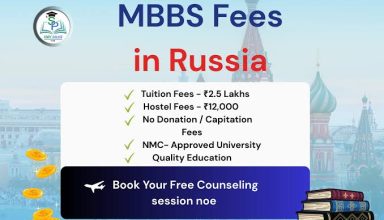
The core appeal is straightforward. Private medical colleges in India often charge Rs. 80 lakh to Rs. 1 crore or more for a five-year MBBS degree, with additional capitation or donation fees that can push costs further. Russia offers a government-funded alternative. Annual tuition fees at Russian medical universities typically range from approximately Rs. 2.5 lakh to Rs. 5.3 lakh per year depending on the university and city. Total six-year costs — including tuition, hostel, food, visa, and living expenses — generally fall between Rs. 25 lakh and Rs. 50 lakh.
No donation. No capitation. Merit-based admission. These are genuine practical advantages for middle-class families looking at medical education seriously.
Russia also has more than 50 government medical universities recognised by the NMC and listed in the World Directory of Medical Schools. The student-to-faculty ratio at many institutions is 7:1, which supports more structured learning environments than many larger institutions elsewhere.
Course Structure
The MBBS programme in Russia runs for six years. The first five years cover academic and clinical coursework. The sixth year is a mandatory internship at the same university. The curriculum is divided into three broad phases. Years 1 and 2 cover foundational sciences — anatomy, physiology, biochemistry, histology. Year 3 serves as a bridge, introducing pathology, pharmacology, and microbiology. Years 4 to 6 involve clinical training across hospital departments — internal medicine, surgery, paediatrics, obstetrics and gynaecology, and other specialisations.
Classes for international students are conducted in English. Russian language training is provided alongside, since clinical rotations require communication with patients in Russian from the third year onward. Students who ignore Russian language training during the first two years often find this transition significantly harder.
NMC Rules: Read Every Point
This section carries the most weight for Indian students. Non-compliance with any of these rules can make the degree unusable for medical practice in India.
NEET is mandatory. From 2018 onward, all Indian students applying to foreign medical universities must have a valid NEET-UG qualification. This is non-negotiable. A NEET score is valid for three years for overseas admission purposes.
Minimum duration of 54 months plus internship. The NMC’s FMGL Regulations 2021 require at least 54 months of academic and clinical coursework, followed by a 12-month internship at the same university. The full programme must be completed at a single institution.
English-medium instruction. The core programme must be taught in English. Clinical training in Russian does not disqualify a student, but the academic programme itself must be officially English-medium. Students should get written confirmation of this from the university.
Full-time, residential programme only. Distance learning and online-only degrees are not recognised by the NMC for medical qualifications.
WDOMS listing is essential. The university must be listed in the World Directory of Medical Schools maintained by FAIMER. Always verify this on the official WDOMS website — not on consultancy brochures.
The March 2026 COVID compensation rule. In March 2026, NMC introduced an important new requirement that many families are not aware of. Students who enrolled in Russian (and some other) universities between 2020 and 2022 and attended online classes during the COVID period must complete additional in-person “compensation training” at their university for those semesters to count toward the required 54 months. This rule affects students in Russia, Kazakhstan, Georgia, and a few other countries. Any student or family with a child in this batch window should contact the university in writing to confirm whether compensation training applies and whether it has been completed. This is far easier to resolve before graduation than after.
Fees: Getting the Real Number
Most websites show tuition-only figures. This is where families get misled.
Tuition at Russian government universities currently ranges from approximately RUB 2,50,000 to RUB 5,30,000 per year — roughly Rs. 3 lakh to Rs. 6.4 lakh per year at current exchange rates. But tuition is only one component of the total cost. A realistic six-year budget must include:
Hostel fees, which range from RUB 20,000 to RUB 1,00,000 per year depending on the university and room type. Food and daily living, which typically add Rs. 10,000 to Rs. 20,000 per month. Visa extension fees, medical insurance, registration costs, and travel — which collectively add Rs. 1 to Rs. 2 lakh per year. Emergency reserves for any unexpected expenses over six years.
When all these are included, a realistic total six-year budget at most government Russian universities falls between Rs. 25 lakh and Rs. 50 lakh, with some lower-cost interior university cities coming in at the lower end of this range. Always ask for an itemised, all-inclusive estimate — not just a tuition line.
City Selection and Safety
Russia is a large country. University location matters significantly in 2026, both for living costs and for safety.
Universities in Russia’s interior — cities like Kazan, Kemerovo, Novosibirsk, Tomsk, Omsk, and the Arkhangelsk region — are situated well away from the western and southwestern border areas and have not experienced any conflict-related disruption.
Universities in southwestern Russia — including Voronezh and Volgograd — are located closer to the Ukrainian border and have experienced documented drone and missile activity targeting defense and industrial facilities in 2025 and 2026. Families evaluating universities in these cities should check the current advisory from the Indian Embassy in Moscow and assess the risk independently.
No direct attacks on university campuses have been reported. The risk is contextual and geographic, not uniform across Russia. However, it is a real factor that must be weighed for a six-year stay.
FMGE: The Post-Graduation Reality
After completing their degree, Indian graduates must clear the FMGE — or NExT, which is expected to replace it — to obtain a medical licence in India. The national FMGE pass rate was 29.62% in December 2024 and 20.89% in June 2024. Russia generally performs better than the national average among countries sending students back to India, though individual university outcomes vary considerably.
This is not a reason to avoid Russia. It is a reason to prepare for FMGE seriously from Year 1 of the programme, not treat it as a post-graduation concern. Students who align their study approach with FMGE preparation throughout the six years consistently perform better than those who begin preparing only in the final year.
University-specific FMGE pass rates should always be sourced from official National Board of Examinations reports — not from consultancy or admission websites where figures are frequently inflated.
Before You Apply: A Practical Checklist
University selection in Russia deserves the same rigour as any other six-year financial and academic commitment. Before applying, it is advised to consult MBBS abroad consultancy and verify the following:
Is the university listed on the official NMC-approved list at nmc.org.in? Is it in the WDOMS directory at wdoms.org? Is the programme officially English-medium, confirmed in writing? What is the actual all-inclusive six-year cost — tuition, hostel, food, insurance, and visa combined? What is the university’s location relative to the conflict zone, and what does the Indian Embassy advisory currently say? What are the FMGE pass rate figures from the official NBE report for recent batches — not from the university’s own marketing material? For students enrolled between 2020 and 2022, has the COVID compensation training requirement been confirmed and addressed?
Final Word
Russia remains a legitimate, affordable, and academically viable pathway for Indian students who want to pursue medicine without the donation-fee burden of Indian private colleges. The advantages are real. So are the requirements — NMC compliance, language adaptation, FMGE preparation, and careful university selection based on location, recognition status, and verified outcomes. Families who go in with clear, accurate information from the start will make decisions that hold up six years later. Those who rely on the lowest fee number they can find online rarely do.